
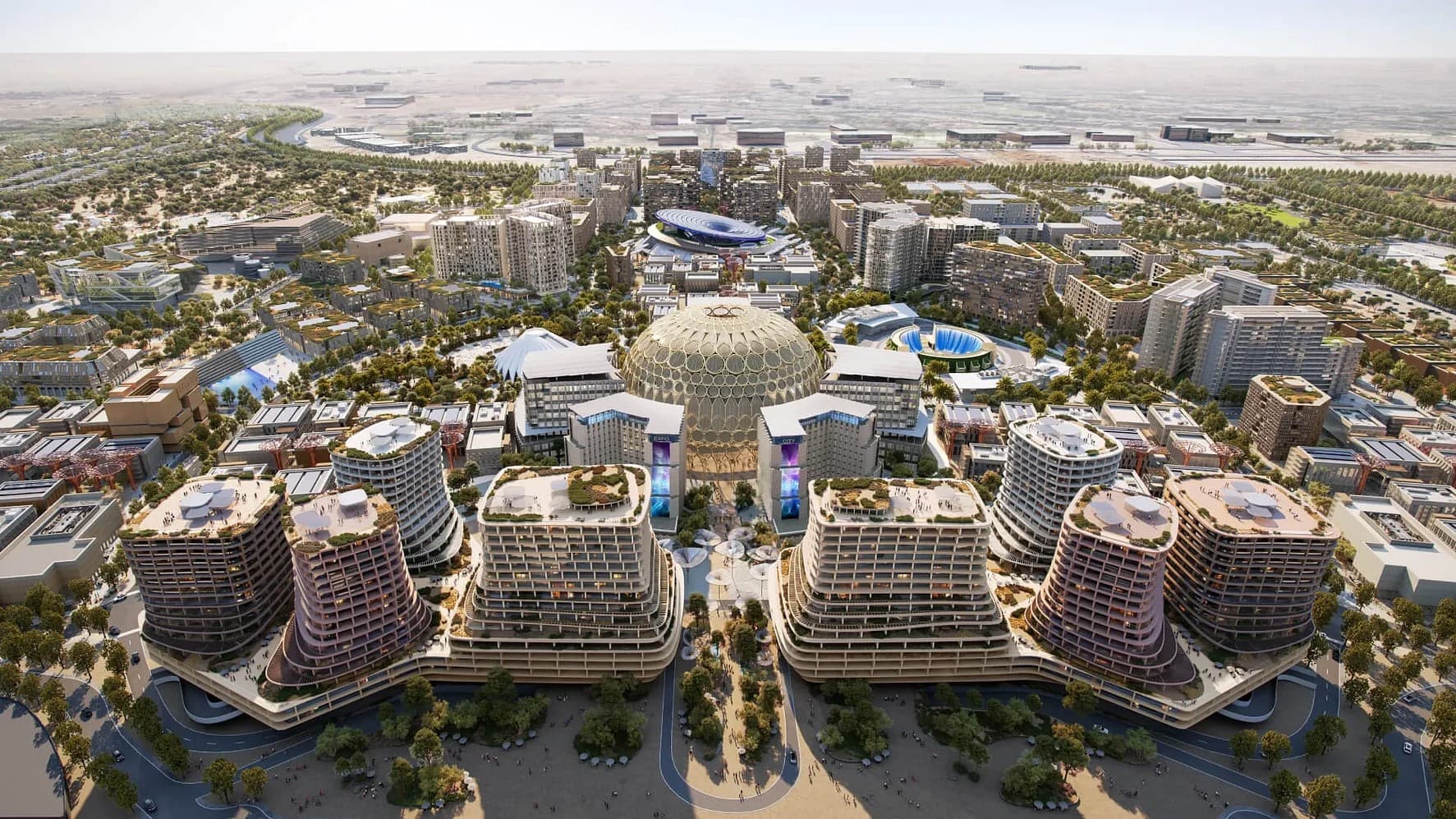
Expo City Dubai
The Expo site, slowly becoming a city.
Buyers who want a government-master-developed district with metro on site and are comfortable arriving before the city does. Best fit for end-users tied to the Expo and Dubai South employment corridor, and patient investors backing the 2028 to 2031 maturity curve.
Anyone who needs a functioning neighbourhood today: the mall is targeted for 2027, the hospital clinic is not open, and the nearest full British-curriculum school sits in neighbouring Dubai South. Yield buyers should wait until the new stock has a rental track record.
What Expo City Dubai trades at.
Government backing and metro access are real, but heavy neighbouring supply and thin traction argue for steady rather than steep appreciation.
The employment base is growing and the only mature precinct blends near 4.4 percent; a middling but improving income profile as the district fills.
Source: Current developer launch pricing, 2026 · Summers ratings are our own judgment. Growth and yield ratings are projections for the developed community.
Expo City is the government's plan for the Expo 2020 site: a public authority established by Dubai law in 2022, now running a genuine events and business district around Al Wasl Plaza. Per Expo City's own reporting, commercial space is over 80 percent leased and new business registrations rose more than 25 percent in the first half of 2026. Residentially, though, only one precinct is actually lived in: Expo Village, 2,273 apartments built for Expo staff and athletes, open to residents since 2022.
Everything under the Expo Living brand is earlier-stage. Mangrove Residences is mid-handover, Sky Residences and the first Shamsa townhouses hand over in late 2026, Al Waha was 47 percent built as of August 2026 for a mid-2027 delivery, and Sidr runs to late 2027. Pricing has climbed through the phases: Bayut's index put the area at roughly AED 2,050 to 2,250 per sqft in mid-2026, with Al Waha up more than 10 percent year on year.
One caution we flag to every client: two different entities sell under the Expo Living name. Expo City Dubai Authority develops Mangrove, Sky, Al Waha, Sidr and Shamsa. A separate Emaar and Dubai World Trade Centre joint venture sells Terra Heights and its siblings in adjacent Dubai South under the same brand. Different developer, different governance, and a real source of buyer confusion.
New launches in Expo City Dubai. Only projects launched in the last 12 months make the list.
Launch pricing and payment plans are the figures the developer published at launch and can change with each release. We confirm current pricing and availability before you commit to anything. Advertised by Summers Real Estate under DLD marketing permit 161130.
A buyer today is buying ramp-up risk, not an established neighbourhood: nearly all stock delivers between 2026 and 2029, the mall and hospital are not open yet, and the published 4.4 percent ROI figure blends softening Expo Village rents against much newer, pricier stock.
Also confirm which Expo Living entity you are actually contracting with.
For its own portfolio, yes: Expo City Dubai Authority is a public authority established by Dubai Law No. 14 of 2022, wholly owned by the government. But Terra Heights next door is an Emaar and DWTC joint venture trading under the same Expo Living brand. Always check who the counterparty on the SPA actually is.
Very little with confidence yet. The only mature rental comp is Expo Village at about AED 95/sqft a year and softening. Broker projections of 6 to 8 percent for the new wave have no disclosed transaction basis. Underwrite conservatively until Mangrove and Sky have a full year of lease data.
Realistically 2029 to 2031. The mall and hospital clinic are targeted for 2027, the main residential waves deliver through 2027, and adjacent phases including the Emaar JV and the Aldar buildings run to 2028 and 2029, with the exhibition-centre expansion targeted at 2031. Budget for construction in the meantime.
Yes and no. The Route 2020 terminus gives direct single-line access into the Red Line, about 40 minutes to Downtown. But DXB by metro is closer to an hour, and daily errands stay car-dependent until the retail opens. Treat the station as a commuting asset, not a car replacement.