
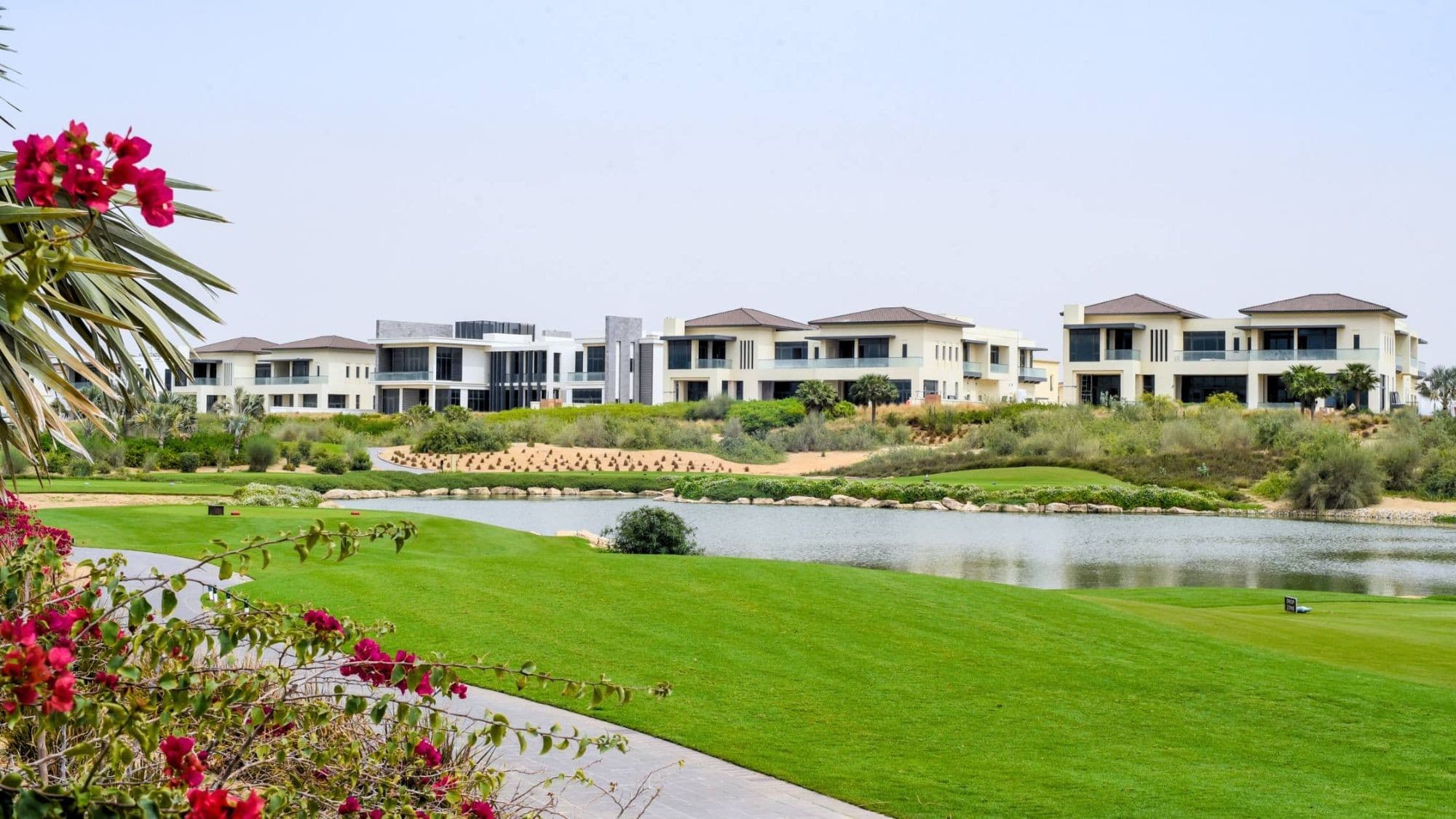
Emirates Hills
Dubai's all-cash enclave.
Established families buying a primary or legacy residence in cash, with a long timeline and no need for income. Buyers who want privacy, golf frontage, and fixed supply more than liquidity.
Anyone who needs financing, yield, or a quick exit. This is the least liquid community we cover: yields compute to 2 to 5 percent at best and a sale can take far longer than the rest of the market.
What Emirates Hills trades at.
| Median price | Per sqft | Median rent | Gross yield | Sales | |
|---|---|---|---|---|---|
| Villas | AED 62.5M | AED 4,080 | AED 3.75M | 6% | 24 |
Short lets are effectively off the table in this gated, family-oriented enclave and short-stay activity is negligible; there is no short-let case in Emirates Hills.
Maximum privacy, golf-course frontage, mature landscaping, and no masterplan construction; the costs are total car dependence and no retail or dining inside the gates.
Source: DLD transaction data via DXB Interact, twelve months to August 2026 · Summers ratings are our own judgment.
Emirates Hills is the only community in Dubai where almost no transaction is financed. Roughly 400 custom-built villas sit on plots overlooking the Montgomerie golf course, built out in the 2000s with essentially no new supply since, which is the point. Just 13 sales reached the DLD register between January and early August 2026, at a median of AED 60M. The buyer pool is cash and multi-generational, and much of the trade happens off-portal, sellers preferring broker-to-broker discretion; a meaningful share of Dubai's AED 20M+ deals close this way, with Emirates Hills the standard example.
Pricing here is dispersion, not a number. Typical resale villas span roughly AED 20M to 90M+, with documented outliers well above AED 140M. This year's DLD sales average AED 3,980 per square foot, individual deals have printed from under AED 2,000 upward, and the July 2026 asking index sat near AED 5,450; in a market this thin, each of those figures is a handful of data points rather than a curve. Plot orientation and golf-course frontage drive the premium more than the build itself, and dated villas are routinely bought for the plot and rebuilt from the shell up.
Emirates Hills is not an income asset. Rental data exists, listed villas asking between AED 1.35M and 3.1M per year, but computed gross yields land around 2 to 5 percent, the lowest of Dubai's prime villa enclaves. You buy Emirates Hills the way you buy land in a capital city: for scarcity, privacy, and the ability to hold it across a generation.
No enclave this small produces reliable averages, so expect a long marketing timeline on both entry and exit, and price from unit-level evidence, never from a published index.
Budget realistically for renovation on dated stock: full architectural upgrades on 20-year-old villas reportedly run well into eight figures.
Tickets are large, the market is illiquid, and the buyer profile rarely needs financing. Mortgage lenders also struggle to value inventory this dispersed: two neighboring villas can differ by tens of millions on build quality alone.
Only a few plots come to market each year, so most buyers renovate. The going pattern is reportedly a purchase around AED 30M followed by a further AED 15M of full architectural renovation. Renovating is faster than a custom build; the design ceiling is lower. The decision usually comes down to timeline more than budget.
Plan on 2 to 5 percent gross, and treat even that range as soft because so few rental contracts register each year. Emirates Hills is a capital-preservation and legacy asset. If income drives the purchase, we would point you elsewhere.
Yes. There is no residency restriction on freehold ownership in Emirates Hills, and the visa pathway typically follows the purchase rather than the other way around.